
The Ultimate Guide to Pizza Styles: A Technical Journey into the Heart of Dough
Introduction
I still remember my first day in the kitchen: flour covering every surface, dough clinging stubbornly to my hands, and one persistent question—why won’t this dough stretch the way I want?
As a gastronomy graduate and professional chef, I eventually realized that we are not simply cooking; we are managing controlled biochemical systems. Pizza dough behaves less like a recipe and more like a living organism—responsive to time, temperature, and environment.
What we call “pizza styles” today are not just culinary variations. They are historical responses to local conditions: humidity, flour quality, fuel type, and even economic pressure.
From the dry, cold air of Northern Europe to the humid density of Naples, pizza has continuously evolved—not through reinvention, but through adaptation.
Estimated reading time: 10 minutes
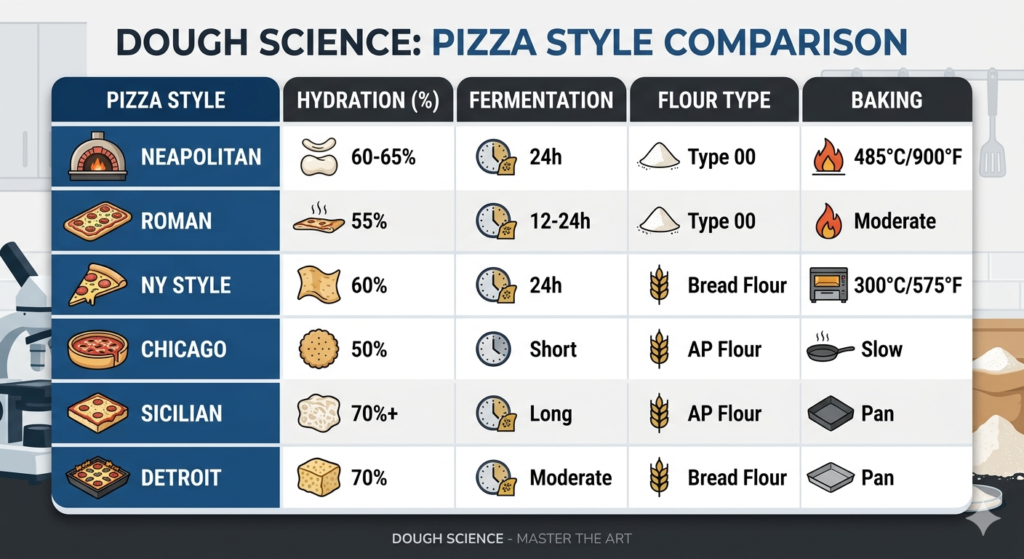
The Dough Science Glossary: Understanding the Fundamentals
Before analyzing pizza styles, it is essential to establish a shared technical language.
Hydration
The ratio of water to flour. Higher hydration increases extensibility and creates a more open crumb structure.
Fermentation
A biological process in which yeast metabolizes sugars, producing carbon dioxide, ethanol, and flavor compounds.
Gluten Development
The formation of a protein network that provides elasticity and gas retention.
Type 00 Flour
A finely milled flour designed for high-temperature baking and controlled extensibility.
Cold Fermentation
Slow fermentation at low temperatures, allowing enzymatic activity to develop flavor while stabilizing yeast behavior.
A key principle: dough quality is not dictated by ingredients, but by how time and temperature are managed.
The European Foundations: Tradition Through Constraint
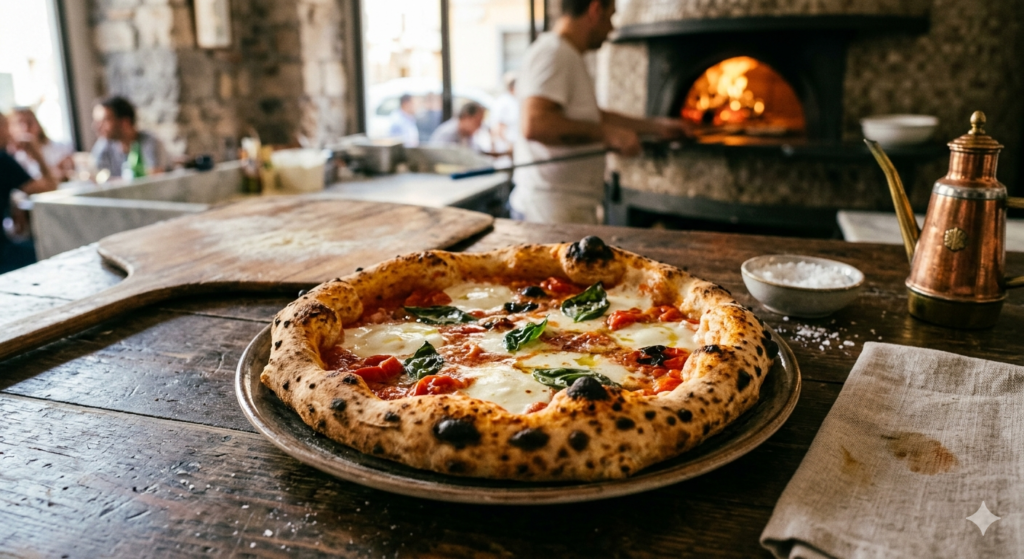
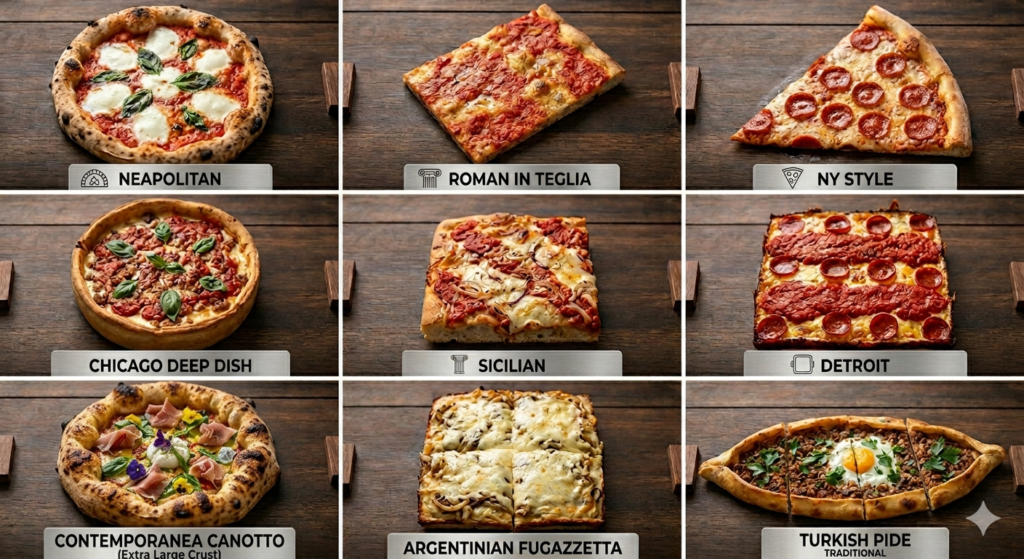
Neapolitan Pizza: Born from Necessity
Neapolitan pizza did not begin as a craft—it began as survival.
In 18th-century Naples, one of Europe’s poorest cities at the time, workers needed food that was fast, cheap, and filling. Street vendors began baking flatbreads topped with tomatoes—then considered a poor man’s ingredient.
What makes Neapolitan pizza remarkable is not complexity, but restraint. It is a system optimized around extreme conditions: very high heat, minimal ingredients, and rapid service.
Structure
Soft, elastic, and highly extensible. Designed to be eaten quickly, often folded.
Technical Parameters
- Hydration: 60–65%
- Fermentation: ~24 hours
- Flour: Type 00
- Baking: ~485°C
Process Logic
The extreme oven temperature forces rapid oven spring before the structure sets, trapping moisture inside. This is why the pizza remains soft rather than crisp.
Neapolitan pizza is not engineered—it is disciplined.
Roman Pizza: Engineering Texture
If Naples is about softness, Rome is about control.
Roman pizza evolved in a different socio-economic environment—one less constrained by speed, and more focused on structure and repeatability. Bakers began experimenting with hydration and baking time to achieve something Naples never aimed for: crunch.
The result is not one style, but a philosophy.
Structure
Crisp exterior with controlled internal air structure.
Technical Characteristics
- Hydration: up to 80%
- Extended baking time
- Use of olive oil
Process Logic
Higher hydration allows for gas expansion, but longer baking removes moisture, creating a rigid crust. Oil interferes with gluten formation, leading to a more brittle texture.
Roman pizza is not about tradition—it is about optimization.
The American Evolution: Scaling the System
New York Style: Built for the City
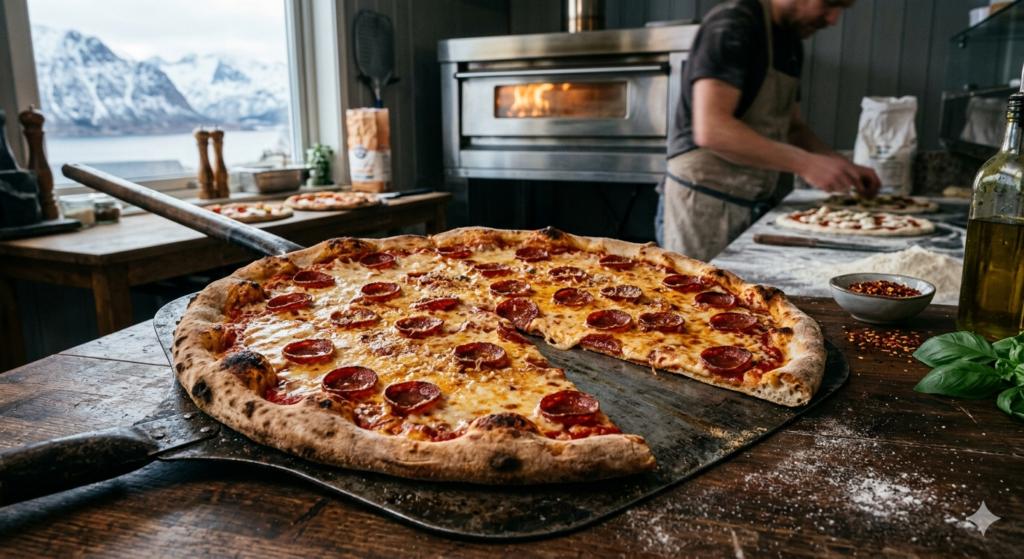
New York pizza is not just a variation—it is a solution.
When Italian immigrants arrived in the early 20th century, they no longer had access to wood-fired ovens or Italian flour. Instead, they adapted to coal and gas deck ovens, American wheat, and the pace of a growing metropolis.
The result is a pizza designed for mobility.
Structure
Large, thin, flexible slices that can be folded and eaten on the move.
Technical Parameters
- Hydration: 60–65%
- Flour: high-protein bread flour
- Fermentation: 24–48 hours
- Baking: ~300°C
Process Logic
Stronger flour compensates for lower baking temperatures. Sugar and oil enhance browning and tenderness.
New York pizza is not about tradition—it is about functionality under pressure.
Detroit Style: Industrial Origins
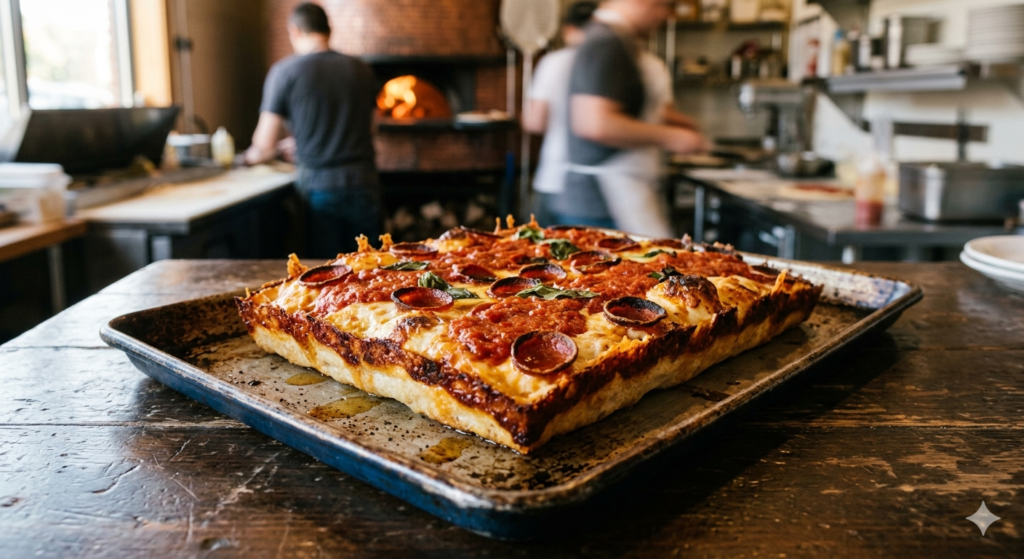
Detroit pizza did not come from a pizzeria—it came from a factory environment.
In the 1940s, workers used blue steel automotive drip trays to bake dough. These pans, designed to withstand high heat, created a unique thermal environment unlike stone or brick ovens.
What started as improvisation became identity.
Structure
Thick, airy interior with an aggressively caramelized crust.
Technical Parameters
- Hydration: 70–80%
- Pan baking
- Edge-to-edge cheese
Process Logic
The steel pan conducts heat efficiently, while cheese at the edges undergoes direct caramelization, forming the signature “frico” crust.
Detroit pizza is not refined—it is industrial logic turned into flavor.
Modern Technical Expressions
Contemporanea (Canotto Style): Precision and Excess
Contemporanea pizza represents the modern obsession with pushing dough to its limits.
Developed by a new generation of pizzaioli, this style takes Neapolitan foundations and amplifies them—more water, more fermentation, more air.
Structure
Extremely inflated rim with large, irregular air pockets.
Technical Parameters
- Hydration: 70–75%+
- Fermentation: 48+ hours
- Preferments: Poolish or Biga
Process Logic
Extended fermentation and pre-ferments increase enzymatic breakdown, improving extensibility and gas retention.
This is not traditional pizza.
It is controlled exaggeration.
Turkish Pide: A Parallel Evolution
Pide developed independently, but under similar constraints: high heat, simple ingredients, and fast service.
However, its priorities differ.
Where pizza seeks air and lightness, pide values structure and immediacy.
Structure
Boat-shaped, denser, more direct.
Process Differences
- Short fermentation
- Lower hydration
- Immediate baking
Technical Insight
Without extended fermentation, flavor comes more from the flour itself rather than biochemical development.
Pide is not a variation of pizza—it is a parallel solution to the same problem.
Technical Comparison
| Pizza Style | Hydration | Flour Type | Fermentation | Baking Temperature |
|---|---|---|---|---|
| Neapolitan | 60–65% | Type 00 | 24h (ambient) | 485°C |
| Roman | 70–80% | Type 00 / AP | 24–48h | 300–350°C |
| NY Style | 60–65% | Bread Flour | 24–48h (cold) | ~300°C |
| Detroit | 70–80% | Bread Flour | ~24h | ~250°C |
| Contemporanea | 70–75%+ | Type 0 / 00 | 48h+ | ~400°C |
Where to Eat in Oslo
Mamma Pizza
A reliable reference for traditional Neapolitan balance.
You can check it
Vinny’s
Focuses on New York-style structure and slice culture.
You can check it
Lofthus Samvirkelag
Modern interpretation with strong fermentation control.
You can check it here

Final Thoughts: Every Style Is a Decision
No pizza style is random.
Each one is the result of constraints:
- available flour
- oven technology
- time
- environment
Understanding pizza means understanding why those decisions were made.
At that point, you stop following recipes—and start building systems.