
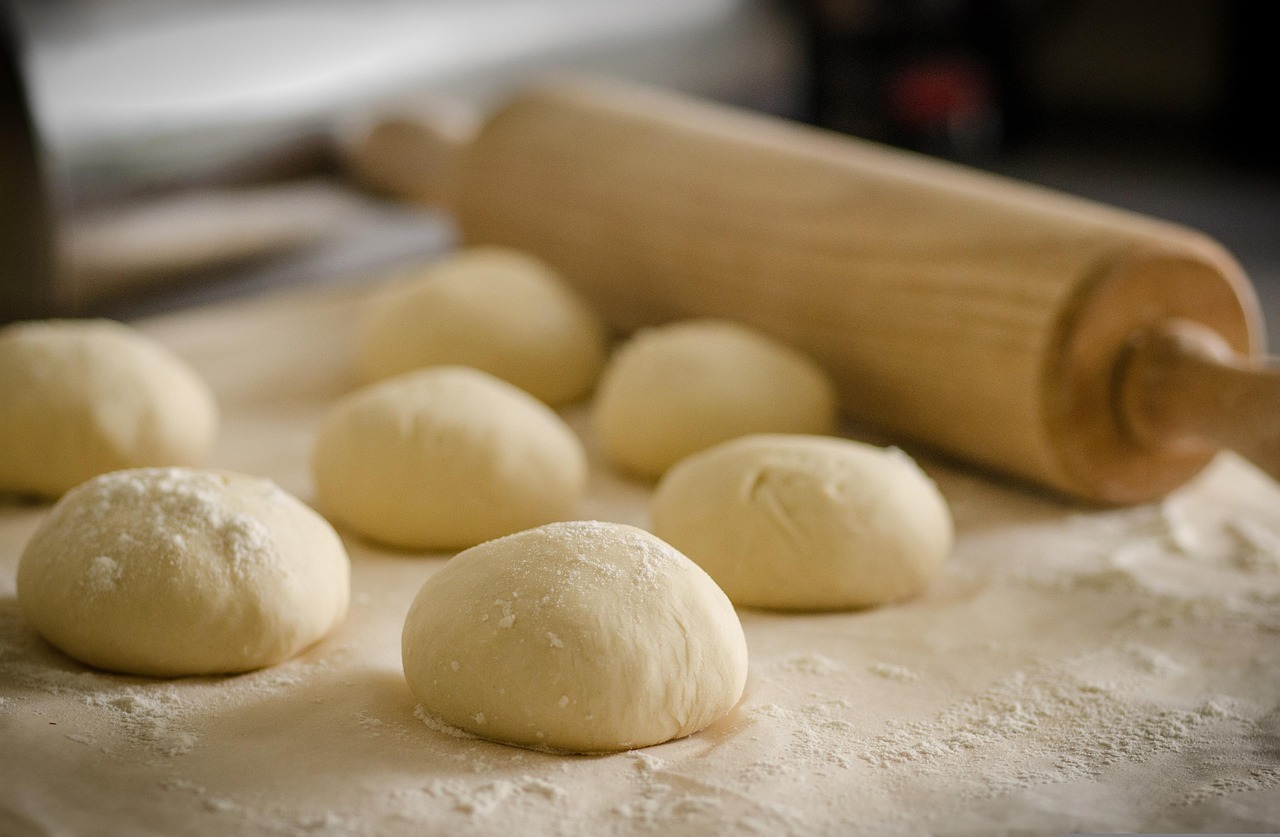
Most home bakers get excellent results from cold fermentation of pizza dough for 24 to 72 hours, and a well-built dough can stretch to 4 or 5 days. The real limit depends on how much yeast you use, how cold your fridge is and how strong your flour is. If you want a reliable 48 hour pizza dough, use a small amount of yeast and a fridge at around 4°C (39°F).
What cold fermentation actually does
Cold slows yeast down but does not stop it. At fridge temperature, yeast produces gas slowly, while enzymes in the flour keep working. Amylase breaks starch into simple sugars, which later feed browning in the oven. Protease gradually breaks down proteins, which relaxes the gluten. Bacteria in the flour also make small amounts of organic acids, which add flavour.
That is why cold-fermented dough tastes more complex, browns more easily and is often easier to stretch. It is also why there is a limit: the same enzymes that improve the dough will eventually weaken it.
What happens at 24, 48, 72 hours and beyond
The timings below assume a dough of about 60-65% hydration, 2-3% salt and a small amount of yeast, held at roughly 4°C (39°F). Treat them as typical ranges, not guarantees.
| Time in fridge | What to expect |
|---|---|
| 12-24 hours | Mild flavour improvement. The dough is easy to handle and rises moderately. A good option if you are short on time. |
| 48 hours | Often the sweet spot. Better flavour, good crust colour, relaxed gluten and still enough strength to hold its shape. |
| 72 hours | More pronounced flavour and very good browning. The dough is softer and stickier, so it needs gentler handling and careful yeast control. |
| 4-5 days | Possible only with very low yeast, a cold fridge and strong flour. Expect a tangier taste and a weaker structure. The risk of over-fermentation rises quickly. |
| 6+ days | Usually past its best. Gluten is often slack, sugars are depleted and the crust browns poorly. |
If you are asking how long pizza dough can sit in the fridge, the practical answer is 3 days for most home recipes, and up to 5 if you have planned for it from the start.
How yeast amount changes the answer
Yeast quantity is the biggest lever you control. More yeast means more gas and faster acid and sugar consumption, so the dough peaks sooner. Less yeast stretches the window.
These are typical starting ranges for instant dry yeast, as a percentage of flour weight:
- 24 hours: about 0.2-0.4%
- 48 hours: about 0.1-0.25%
- 72 hours: about 0.05-0.15%
- 4-5 days: about 0.03-0.1%
Illustrative example: for 500 g of flour, 0.2% instant yeast is 1 g, and 0.1% is 0.5 g. Measures this small need a scale accurate to 0.1 g or 0.01 g. Without one, mix a larger batch or dissolve a measured amount in water and weigh out a fraction of it.
As a rough guide, fresh yeast is about three times the weight of instant yeast, and active dry is slightly more than instant. Check your packet, because brands differ.
How fridge temperature changes the timeline
Most home fridges run between 2°C and 6°C (36-43°F), and temperatures vary by shelf. A dough at 2°C (36°F) ferments much more slowly than one at 6°C (43°F). A dough that sits at the back of a cold shelf can behave quite differently from one in the door.
- Use a fridge thermometer to find out where your dough really sits.
- Mind the starting temperature. Aim for a mixed dough of about 22-24°C (72-75°F). Colder water helps if your kitchen is warm.
- Remember that deep containers cool slowly. A large tub of dough can stay warm in the centre for hours, so it ferments more before it chills.
- Expect faster results in a warm fridge. If yours runs near 6-7°C (43-45°F), reduce the yeast or shorten the time.
How to cold ferment step by step
- Weigh everything. A common starting point is 500 g flour, 300-325 g water (60-65%), 10-15 g salt (2-3%) and your chosen yeast amount.
- Mix and knead until the dough is smooth and cohesive. Aim for the 22-24°C (72-75°F) range.
- Rest briefly at room temperature for 30-60 minutes, then divide into balls of about 250-280 g for 25-30 cm (10-12 inch) pizzas.
- Place each ball in a lightly oiled, covered container or tray with a lid, leaving room to grow.
- Refrigerate for 24-72 hours.
- Warm up before baking. Take the dough out 1-2 hours ahead, depending on room temperature, until it is soft, relaxed and slightly puffy.
- Bake hot. Preheat a stone or steel in your oven at its maximum, usually 250-280°C (480-535°F), for 45-60 minutes.
Signs your dough is over-fermented
Over-fermented dough has used up too much of its food and its structure has broken down. Look for these signs:
- Slack, sticky texture that will not hold a ball shape and spreads flat.
- Tearing when you stretch it, or a skin that will not hold gas.
- A collapsed, deflated surface with large bubbles that have popped.
- A strong sour or alcohol smell, much sharper than a pleasant yeasty aroma.
- Pale crust that refuses to brown, because the sugars are used up.
- A dense, gummy or cracker-like bake with little oven spring.
If the dough is only slightly past its best, you can sometimes rescue it. Handle it gently, use plenty of flour or semolina on the peel, bake at maximum heat and consider a thinner, crisper style. If you see mould or pink or grey patches, discard it.
Quick checklist before you commit to a long ferment
- Is your yeast measured in grams, not guessed?
- Is the yeast amount matched to your planned time (see the ranges above)?
- Is the mixed dough at about 22-24°C (72-75°F)?
- Do you know your fridge temperature?
- Is the dough in an oiled, covered container with room to expand?
- Are you using a flour with enough protein for long fermentation, typically 11-13%?
- Have you planned time to bring the dough to room temperature before baking?
FAQ
Can I use pizza dough after 5 days in the fridge?
You can, if you started with very little yeast, a cold fridge and strong flour. Check for the over-fermentation signs above. If the dough is slack, very sour or collapsing, it is better to bake it as a flatbread or discard it.
Should I let the dough rise before putting it in the fridge?
Cover photo: ClickerHappy on Pixabay