
The Ultimate Guide to Pizza Dough Hydration: Science, Flour, and Mastery
Reading Time: 15 Minutes
Category: Dough Science / Professional Techniques
Focus Keywords: Pizza dough hydration, flour absorption rate, W value, high hydration sourdough, water temperature, Neapolitan pizza science.
In the world of high-end gastronomy, the difference between a “good” pizza and a “world-class” pizza often comes down to a single gram of water. If you want to move beyond basic recipes and truly understand Dough Science, you must master Hydration.
1. What Exactly is Hydration? (The Baker’s Percentage)
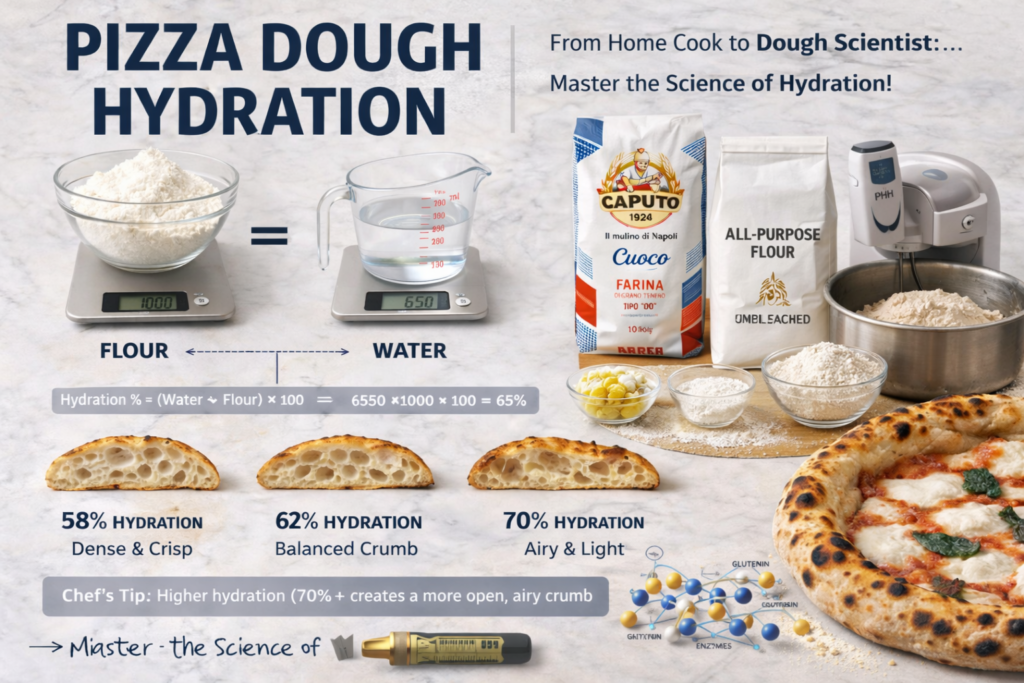
In a professional kitchen, we never use volume (cups/milliliters). We use the Baker’s Percentage. Hydration is the ratio of water to the total weight of flour.
The Formula: > $(Water Weight / Flour Weight) \times 100 = Hydration \%$
For example, if you use 1000g of flour and 700g of water, you are working with 70% hydration. But why does this number fluctuate? Because water isn’t just an ingredient; it’s the catalyst for everything that happens inside your dough.
2. The Biological Role of Water: Gluten and Enzymes
Water is the “engine” of your dough. Without it, your flour is just dust.
Gluten Development
Flour contains two main proteins: Glutenin (for strength) and Gliadin (for elasticity). These proteins only bond to form Gluten when they are hydrated.
- High Hydration: Allows proteins to move more freely, creating a more extensible (stretchable) dough.
- Low Hydration: Creates a tighter, more “rubbery” structure that resists stretching.
Enzymatic Activity & Flavor
Water triggers Amylase, an enzyme that breaks down complex starches into simple sugars. These sugars are the primary food source for your yeast. If you are doing a long fermentation, the water level determines how efficiently your yeast can “eat” and produce the $CO_2$ needed for that airy crust.
3. The “W” Factor: Why Your Flour Choice Dictates Your Water
This is where 90% of home bakers fail. They try to apply a 75% hydration recipe to a weak supermarket flour.
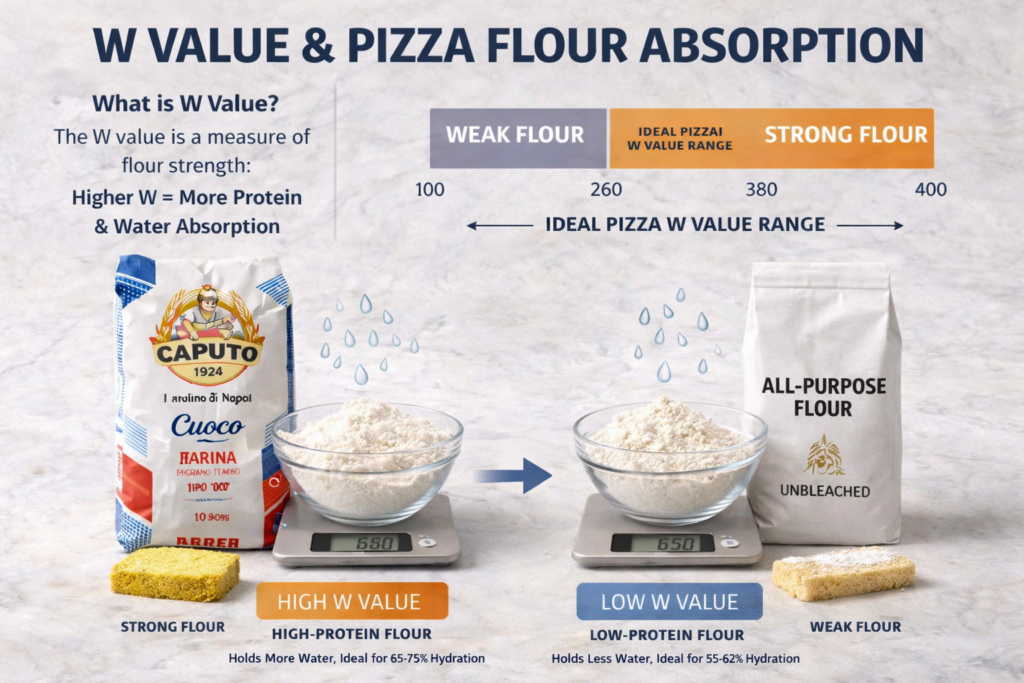
The Strength (W Value): Professional flours, like Antimo Caputo or Molino Dallagiovanna, have a “W” rating that measures strength.
- W200 – W240 (Weak): Can only handle 55-60% hydration. Use these for short ferments or crackers.
- W280 – W320 (Strong): The “sweet spot” for Neapolitan pizza. Can handle 62-70% hydration easily.
- W350+ (Super Strong): These “thirsty” flours can absorb up to 80-90% water (often used for Pizza in Teglia).
If you are unsure about which flour to buy for your specific oven, check our Frequently Asked Questions for a breakdown of professional flour brands.
4. Advanced Technique: The “Double Hydration” Method
When working with high hydration (70%+), adding all the water at once can make the dough impossible to knead. Professional pizzaiolos use the Basseggio or Double Hydration technique:
- Start by mixing all the flour with 60% of the water.
- Develop the gluten structure until the dough is smooth and strong.
- Slowly add the remaining 10-15% water in small “trickles” while the mixer is running.
This allows the gluten to stay strong while “trapping” the extra water inside the structure. This is a technique I often teach during my [1-on-1 Consulting Sessions] for chefs moving into contemporary pizza styles.
5. Environmental Factors: From the Mediterranean to the Arctic
One of the core principles of Dough Science is that a recipe is never static.
The Humidity Variable
- In High Humidity (Croatia): Flour is naturally moist. You may need to decrease your water by 1-2% to prevent the dough from becoming a sticky mess.
- In Dry/Cold Climates (Norway): Flour is “thirsty.” In my current kitchen in Finnsnes, I often increase hydration to keep the dough supple and prevent a dry, “biscuit-like” crust.
Water Temperature Control
The temperature of your water is your “brake” or “gas pedal” for fermentation.
The Pro Formula: > Target Dough Temp (23°C) × 3 – (Room Temp + Flour Temp + Friction) = Required Water Temp
6. Hydration and Your Oven Type
You must match your water to your heat source:
- Wood-Fired (450°C+): Needs lower hydration (58-62%). The intense heat cooks the pizza in 60-90 seconds. If the dough is too wet, it won’t crisp up in time.
- Home Oven (250-300°C): Needs higher hydration (65-70%). Because home ovens take 5-8 minutes to cook a pizza, the dough loses more moisture during the bake. Higher hydration keeps the inside soft while the outside gets crunchy.
7. Common Troubleshooting
- “My dough is too sticky to handle”: You likely over-hydrated for your flour’s strength. Try a series of Stretch and Folds every 20 minutes to build strength without adding flour.
- “My crust is hard and dry”: Your hydration was too low for your bake time. Increase by 3% next time.
- “The dough won’t stretch”: It’s under-hydrated or too cold. Let it rest!
Conclusion: Data Over Guesswork
Mastering hydration is about moving from “guessing” to “knowing.” By aligning your flour’s W value, your environment’s humidity, and your oven’s temperature, you unlock the secrets of the world’s best pizzerias.
Are you a restaurant owner struggling with consistency? Inconsistent dough is the number one killer of profit. I provide Professional Consulting Services to help you stabilize your production, train your staff, and optimize your hydration levels for maximum quality and minimum waste.